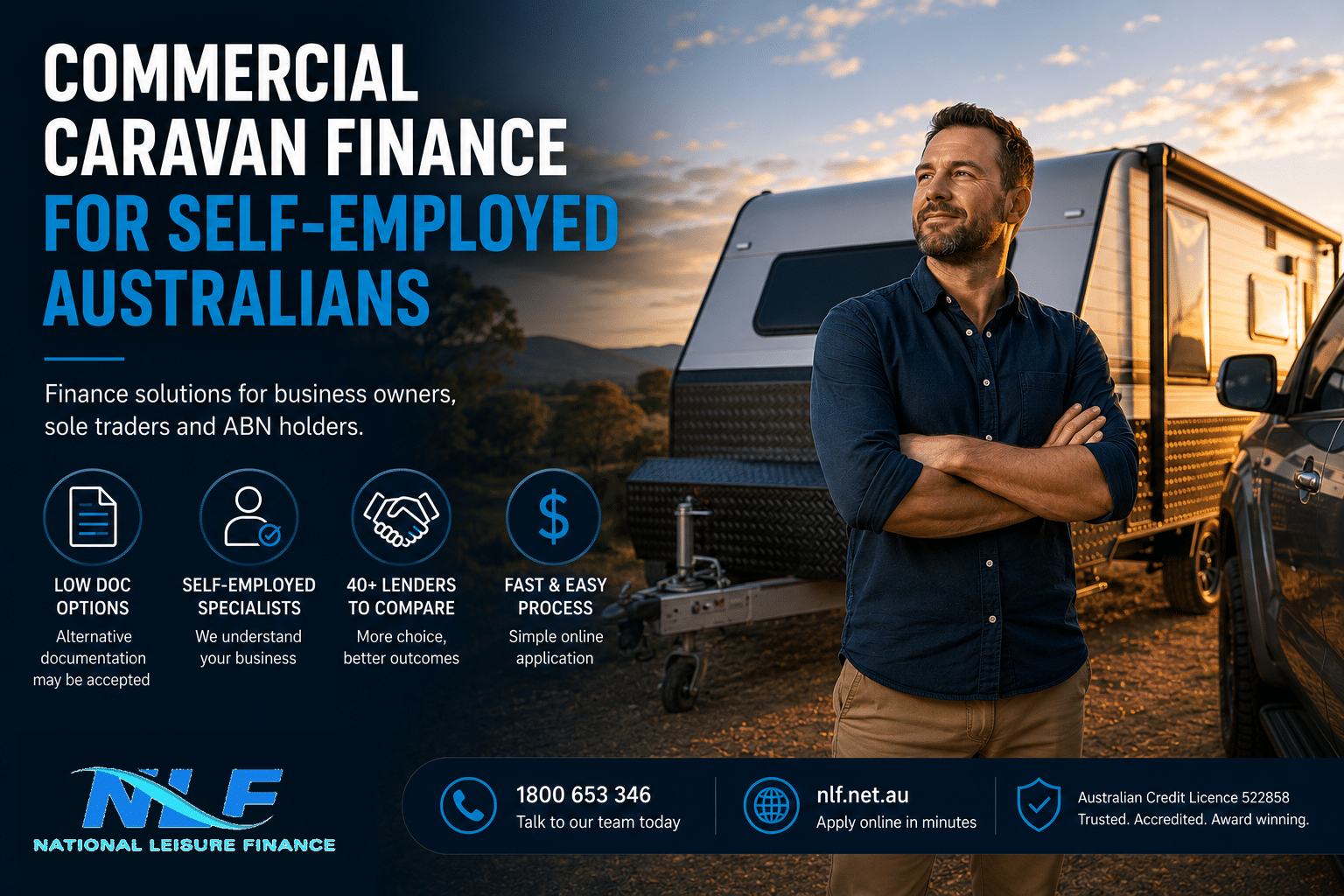
Being self-employed should not automatically make financing a caravan difficult. But for many business owners, sole traders and ABN holders, proving income using the documents required by a traditional consumer lender can be more complicated.
You might have a strong business, healthy cash flow and a clear reason for purchasing a caravan, while your latest tax returns or full financial statements are not yet available. In the right circumstances, commercial caravan finance may provide another way for an eligible self-employed applicant to finance a caravan that has a genuine business or commercial purpose.
National Leisure Finance works with a panel of more than 40 lenders and can assess both consumer and commercial caravan finance options. That gives our brokers the ability to look beyond a single lender’s policy and identify finance structures that may better suit the applicant, the business and the intended use of the caravan.
Commercial Caravan Finance for Self-Employed Australians: Quick Answer
Can a self-employed Australian get caravan finance without providing full financial statements?
Potentially, yes. Some commercial lenders offer low-doc or alternative-documentation options for eligible self-employed applicants where the caravan is being acquired for a genuine business or commercial purpose.
That does not mean no assessment is required. The lender may still consider factors such as your ABN history, business activity, credit profile, asset, deposit or equity position, loan amount and the purpose of the caravan. Documentation requirements vary between lenders and applications.
Why Can Caravan Finance Be Harder When You’re Self-Employed?
A PAYG employee will often have recent payslips and regular salary deposits that make income relatively straightforward for a lender to verify.
Self-employed income can look very different.
- Your latest tax return may not reflect how the business is performing today.
- Your accountant may still be preparing the most recent financial statements.
- Your income may vary throughout the year.
- You may operate through a company, partnership or trust rather than receiving a conventional wage.
- Legitimate business expenses and deductions can reduce taxable income.
- Your business may be growing faster than historical financial statements suggest.
None of those circumstances automatically means the applicant cannot obtain caravan finance. It means the application may need to be matched with a lender whose assessment method suits the applicant’s actual circumstances.
What Is Commercial Caravan Finance?
Commercial caravan finance is finance used to acquire a caravan or similar leisure asset where there is a genuine business or commercial purpose for the purchase.
Depending on the borrower, asset and lender, the finance may be structured differently from a standard consumer caravan loan.
The distinction matters. ASIC explains that consumer credit laws generally apply where credit to an individual is provided wholly or predominantly for personal, domestic or household purposes. Commercial lending can be treated differently, so the actual purpose of the finance is important.
ASIC provides further information about consumer and commercial loans.
A commercial loan should therefore not simply be selected as a way of avoiding the requirements that apply to consumer finance. There needs to be a legitimate commercial basis for the transaction and the application must meet the chosen lender’s criteria.
Do Self-Employed Applicants Need Tax Returns for Commercial Caravan Finance?
Not necessarily in every case.
Some commercial lenders may assess eligible applications without requiring the same complete set of tax returns and financial statements expected under a traditional full-doc application.
The evidence required depends on the lender and the strength and structure of the application. A lender may instead consider other information relevant to the business and transaction.
This is one reason working with a broker can be particularly useful for self-employed applicants. Instead of assuming every lender will assess the application in the same way, NLF can compare the application against the policies available across our lender panel.
What Does Low-Doc Caravan Finance Mean?
Low-doc does not mean no-doc.
Low-documentation commercial finance generally means an eligible applicant may be assessed using reduced or alternative documentation rather than a conventional full set of financial statements and tax returns.
Exactly what is accepted varies by lender. The lender still needs enough information to assess the application under its commercial credit policy.
Claims that business finance requires no assessment at all should be treated cautiously. A legitimate low-doc application still involves lender eligibility requirements and credit assessment.
What If My Latest Financials Aren’t Finished?
This is one of the situations where speaking with a broker before assuming finance is unavailable can be worthwhile.
A business may be trading well even though its latest accounts have not been finalised. Your accountant might still be preparing them, or the most recently completed tax return may relate to an earlier period that no longer represents the business accurately.
Depending on the circumstances, NLF can determine whether there are commercial lenders on our panel whose documentation requirements may accommodate the application.
That does not guarantee approval, but it can prevent an applicant from ruling themselves out simply because they do not currently have a conventional full-doc package ready.
Who Can Apply for Commercial Caravan Finance?
Commercial caravan finance may be relevant to a range of Australian business structures, subject to lender policy and the purpose of the purchase.
- Sole traders
- Companies
- Partnerships
- Eligible trust structures
- ABN holders
- Established self-employed business owners
The length of time the business has been operating can matter. Some lenders have minimum ABN or trading-history requirements, while others may consider different circumstances. There is no single rule that applies across every lender.
Does the Caravan Need to Be Used for Business?
For genuine commercial caravan finance, the purpose of the purchase matters.
Examples could include a caravan or similar asset genuinely used in connection with business operations, mobile work, accommodation associated with commercial activity or another legitimate business purpose accepted by the lender.
If the caravan is being purchased predominantly for private holidays and personal recreation, a consumer caravan finance option may be more appropriate.
NLF can discuss the intended use with you and determine which type of finance is appropriate before approaching a lender.
What Types of Caravans Can Be Commercially Financed?
Subject to lender criteria and the commercial purpose of the transaction, finance may be available across a range of leisure assets.
- New caravans
- Used caravans
- Off-road caravans
- Hybrid campers
- Camper trailers
- Motorhomes and other eligible recreational vehicles
The age, value, condition and type of asset can affect which lenders are suitable. You can also explore the caravan and RV brands NLF finances.
Can I Finance a Caravan From a Dealer or Private Seller?
NLF can assist with eligible dealer and private-sale caravan purchases.
Private sales can involve additional checks and settlement requirements because there is no dealership managing the transaction. The lender may require information about the seller, asset, registration, valuation and security before settlement.
If you’re considering a private purchase, our guide to private sale vs dealership caravan finance explains the differences in more detail.
Why Use a Broker for Self-Employed Caravan Finance?
The biggest challenge for many self-employed borrowers is not necessarily whether finance exists. It is knowing which lender is likely to suit the application.
Different lenders can have different policies around business history, documentation, asset age, loan size, deposits, credit profiles and commercial use.
National Leisure Finance has access to more than 40 lenders. That allows our brokers to assess the application against multiple lender policies rather than relying on the criteria of one bank or finance company.
Read more about why using a finance broker can help when comparing caravan finance.
What If My Bank Has Already Said No?
A decline from one lender does not necessarily mean every lender will reach the same decision.
The bank may have a documentation requirement or credit policy that does not fit the application. Another lender may assess self-employed applicants differently.
However, it is important not to submit applications indiscriminately to multiple lenders. Each application should be considered carefully so that the lender selected has a reasonable policy fit for the circumstances.
Commercial Caravan Finance vs Consumer Caravan Finance
The right structure depends primarily on the purpose of the purchase and the applicant’s circumstances.
| Commercial caravan finance | Consumer caravan finance |
|---|---|
| Used for a genuine business or commercial purpose | Used predominantly for personal, domestic or household purposes |
| May offer low-doc or alternative-documentation pathways for eligible applicants | Typically involves consumer lending income-verification requirements |
| Commercial lender policies apply | Consumer credit requirements apply |
| May suit eligible self-employed borrowers and businesses | May suit buyers purchasing primarily for private recreation |
The fact that someone is self-employed does not by itself determine which loan type should be used. The purpose of the borrowing remains critical.
What About GST and Tax Deductions?
The tax treatment of a commercially financed caravan depends on the business, ownership structure, use of the asset and individual circumstances.
Potential GST treatment, depreciation and deductibility should be discussed with your accountant or qualified tax adviser.
National Leisure Finance provides credit assistance, not tax advice. We can help arrange suitable finance, but your accountant or tax adviser should advise you on the tax consequences of purchasing and financing the asset.
Why Self-Employed Caravan Buyers Choose NLF
National Leisure Finance specialises in caravan and leisure finance and assists customers Australia-wide.
- 40+ lenders available across our lender panel
- Consumer and commercial caravan finance options
- Experience with self-employed and ABN-holder applications
- Dealer and private-sale purchases
- New and used caravans
- More than 3,000 customers financed
- Winner of the 2026 Fintelligence Award for Best Brokerage Under 5 Brokers
Our role is to understand the application first, then identify suitable lenders and finance structures from our panel. Approval, rates, terms and documentation requirements remain subject to the selected lender’s criteria.
Commercial Caravan Finance FAQs
Can self-employed Australians get commercial caravan finance?
Yes, potentially. Eligibility depends on factors including the business, intended use of the caravan, applicant profile, asset and lender criteria.
Can I get caravan finance without full financial statements?
Some commercial lenders may offer low-doc or alternative-documentation options for eligible applicants. Full financial statements are therefore not required for every commercial application, but documentation requirements vary by lender.
Can I get commercial caravan finance without tax returns?
Potentially. Some eligible applications can be assessed without conventional tax returns, depending on the lender and circumstances. Other supporting information may still be required.
Does low-doc mean no documents?
No. Low-doc generally means reduced or alternative documentation. The lender still assesses the application and may request evidence relevant to its commercial credit policy.
Do I need an ABN?
Commercial lenders commonly have requirements relating to the applicant’s business or ABN. The exact requirements and minimum trading history vary between lenders.
How long does my ABN need to have been registered?
There is no single minimum that applies to every lender. Some lenders require a longer trading history than others, which is one reason lender selection matters.
Can a sole trader apply?
Yes. Sole traders may be eligible for commercial caravan finance where the transaction has a genuine business purpose and the application meets lender criteria.
Can I finance a used caravan?
Potentially, yes. Used caravans can be financed subject to lender requirements relating to factors such as age, value, condition and security.
Can I buy a caravan privately using commercial finance?
Potentially. NLF can assist with eligible private-sale transactions, although additional asset, seller and settlement checks may be required.
What if my accountant hasn’t finished my latest financials?
Speak with NLF before assuming you cannot apply. Depending on your circumstances, there may be a lender whose documentation requirements can accommodate an eligible application without a conventional set of completed financial statements.
Does commercial caravan finance guarantee approval?
No. All finance remains subject to lender approval, eligibility, credit criteria, acceptable security and any required documentation.
Can NLF compare different commercial lenders?
Yes. National Leisure Finance has access to more than 40 lenders. We can assess which lenders on our panel may suit the applicant, transaction and intended use of the caravan.
Talk to NLF About Commercial Caravan Finance
If you’re self-employed and want to finance a caravan for a genuine business purpose, you do not need to assume that unfinished financial statements or an unconventional income structure automatically rules you out.
National Leisure Finance can review your circumstances, explain the information likely to be required and compare suitable options from our panel of more than 40 lenders.
Apply online or call 1800 653 346 to speak with the NLF team.
National Leisure Finance Pty Ltd holds Australian Credit Licence 522858. Information in this article is general in nature and does not take into account your objectives, financial situation or needs. Commercial and consumer finance have different eligibility, documentation and regulatory requirements. Finance is subject to lender approval, eligibility, credit criteria, acceptable security, fees and charges. National Leisure Finance does not provide tax advice.